
Interview with Rasheeda Alford - Black Mental Health Awareness Month
For Black Mental Health Awareness Month, Nuçi’s Space Health & Wellness Program Manager Stephan Eūtsler sat down with Rasheeda Alford of Revolution Therapy and Yoga to discuss the importance of culturally responsive care, representation, access, and breaking down stigma within Black and BIPOC communities. A Licensed Master Social Worker and therapist, Rasheeda brings a holistic, culturally informed approach to her work, incorporating both traditional therapeutic practices and somatic healing. She shares her perspective on why finding a therapist you can relate to, and who makes you feel truly seen and understood, can make such a meaningful difference in the therapeutic process.
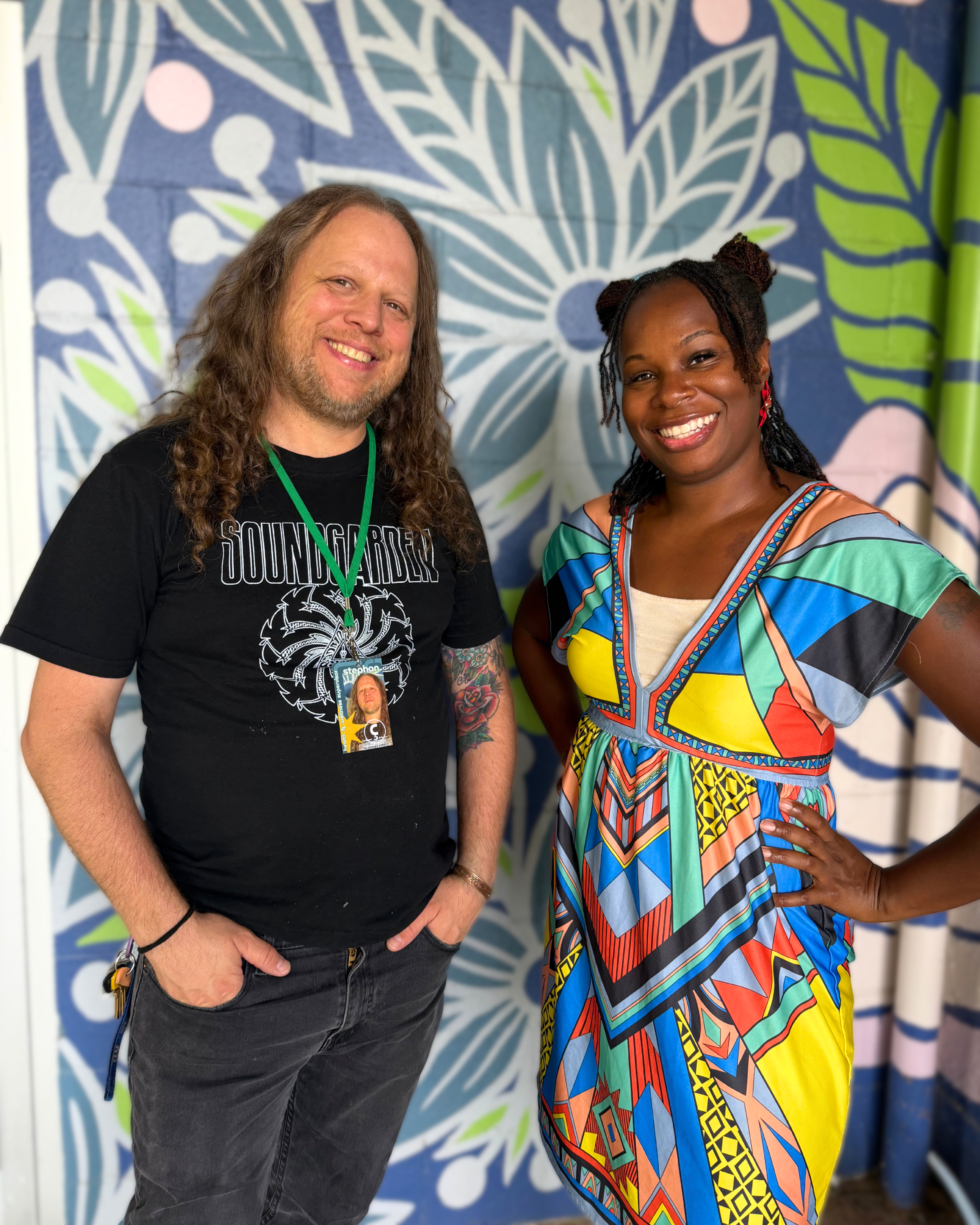
Nuçi’s Space Health & Wellness Program Manager, Stephan Eūtsler and Nuçi’s partner, Licensed Master Social Worker and therapist, Rasheeda Alford standing outside Nuçi’s Space.
How do you determine the collective experience and/or trauma People of Color face, and do you feel they are supported completely and represented by the mental health care industry?
Stephan: [laughs] That’s a big one to rip right off, right?
Rasheeda: [laughs] Yes. So, when I was thinking about this question, I was like, “Well, first of all…” It’s so many layers and levels, and it’s a complex thing, right? When you think about typical trauma stuff in the therapy setting…people might come in for one incident, like a traumatic incident. Or they can think about several traumatic incidents, things they want to address. So when we think about BIPOC populations and the way they experience complex trauma, when we’re talking about racial trauma, we can’t pinpoint just one incident. It’s a series of things that have been happening since the beginning of the history of this country. Daily experiences. How do you address something like that? How do you conceptualize something like that? When a person is coming in, and they’re talking about racial trauma, like, “ I can’t remove a person from my life. They did this incident, they’ve been a perpetrator. I can’t remove myself. I can’t take my skin off, right?”
You have to be able to understand just how complex trauma is for people in BIPOC communities. It may not be something that is happening to them directly but it’s something that’s happening to a family member or a friend, and something that they’re constantly being exposed to. So that’s something we have to be very sensitive to, first of all. I don’t know if that answers the question, but that is what came to my mind. Understanding that it’s a daily thing that’s happening over and over again and how that impacts and stresses the people in those communities.
Stephan: Absolutely. And you said “racial trauma” - that’s exactly what I’m talking about. It has to be said. There’s scientific proof that trauma is generational, that it’s hereditary and it manifests in so many different ways. You can’t go back and fix any of it. But you can start today, start having the conversations. Being open is a problem in many families. I don’t know if that’s a cultural thing at all, that’s just a human being. But we’re not talking about everybody else right now.
Rasheeda: One part I had forgot to mention was that…again, how do you heal something - understand the complexities that people are being told there’s something wrong with you and what you look like. And like I said, you can’t take your skin off. So the complexities of that and being able to support them through that and validate it without being dismissive. “Slavery ended a long time ago”; comments like that, it’s very much alive. Even if you’re just opening up your phone to go on social media, the things that are being pushed in your face just because of who you are. And you can’t change it. So again, with typical trauma, there’s something we can easily identify to and point to and say “let’s get you out of this situation and help you.” But when someone is like, “It’s the color of my skin!” - how do you heal that?
Stephan: Yeah, because there’s many traumas that come from that, but there’s one – you saying validating made me think of a person with brown skin this country, no matter where they’re from – appearance is what those people see in the mirror, so yeah, it’s like any other childhood trauma but here again, in the sense of, “I was told these things”. Some differential association type stuff. My goal is to figure out, “OK, these are the things, these are absolutely important. We’re not going to “tolerate”, we’re going to embrace it. Because “tolerate” can be a very negative word. Let’s embrace this and let’s see how we can fix the basic things, and then create some value. But it is hard.
And you brought up an interesting point about your phone…like, the amount that people don’t understand, the thing that happened with George Floyd…I say “thing”, I don’t mean to demean it. But if you look like George Floyd, and there’s - that’s traumatizing. That’s terrible.
Rasheeda: To the second part – do we feel supported, represented in the mental health care industry? I would say we have come a long way, but we have an even longer way to go. Just even in my training in school, all of the theories that began the whole foundation of this was with white men. White men saying what was wrong with everyone else in the world. So you have a system that is built on “the white man said, this is what it is and this is how it should be”. ]There’s a lot of theories that have evolved, and that are a lot more strength-based about not what’s wrong with you but what’s right with you. And that was the beginning of things, but now we’ve come even further to have more race-based things and culturally appropriate based interventions and we’ve come a long way with that. But where we have some lack is, particularly with Black people, we’re almost 14% of the population. But as far as providers, we only make up 4-5% out of everybody else. That is a very low number. And so we are highly underrepresented in service providers, and so Black people who do decide they need support, there’s a barrier because you want me to tell all of my business - my deep, deep dark business, to somebody that might not look like me. To somebody who, yes, somebody who historically I have had fears about because if you think medically, things that have happened…like if you think about the syphilis experiments…there are things that have happened, and mistrust of. So that’s one thing.
If you go to racism, slavery…this community is afraid to go and get help, because not only is it taboo in the community, it’s like, “no, you go to church. You pray. You don’t tell our business about the home. What happens in the home stays in the home.”…that is a cultural thing. And now you want me to go tell someone who doesn’t even look like me? It’s hard.
I think that there needs to be more effort early on to support Black students. Getting Black students exposed to the fields of social work or psychology earlier and understanding what therapy actually is. There’s a lot of stigma about what therapy is about. Being able to expose Black students and Black families, period. And BIPOC families period. Because that’s one of the questions I ask early, when people come to my office. If they’ve never had therapy before, I ask, “What do you think therapy is?” Letting them know this is a place to come get support. All of us have our challenges. Being able to have a place where you can talk to somebody who’s not going to go tell your business, I’m not going to tell you what to do, and I’m not going to tell you how to live your life. We need more BIPOC providers, we absolutely do.
Stephan: It’s interesting that that is the stat. You fill out a form and it asks, “are you white, are you caucasian, are you African American, what are you?” And it’s like, “if you put all of those people that aren’t white, they aren’t actually really a minority.” If I’m hearing you right,both ends of the spectrum need to create a culture that creates a sense of sovereignty from the bottom up to the top down and the left to the right.
You also touched on something really interesting. In my experience in my family, some of the generation before us, certainly my mom but definitely my wife’s mom, who is Black…why would a person want to go to a therapist , if they’ve already been told how terrible they are to start with. Because that’s what I hear, “I don’t need to be told what’s wrong with me.” We’re trying to do the opposite. There’s a certain amount of guilt that comes from other races, like, “you want to believe that something’s wrong with you.” The experience of being completely ostracized, unincluded from everything, just about. Having to create some sort of sense of community.
Rasheeda: Absolutely.
How can we make it better?
Stephan: We talked about that a little bit. I don’t know if there’s a better - a direct path. One of the things I understand is that we’re really talking about who is going to pay for it?
Rasheeda: Yep.
Stephan: I believe, and you believe, if we could write an open check, we would do it. And trust that people have the best interests in mind. That’s what it comes down to. We could be conceptual as much as we possibly can, but when it comes to getting the money, it’s like, “where is the money going, and where is it coming from?” I don’t know how much research it takes. I think that everybody knows what’s up. It takes boots on the ground.
Rasheeda: It all comes down to the mighty dollar. Where they want to put it.
Stephan: Whoever “they” is. And even talking about that is a nuanced thing,because what we would like is for everybody to go, “where do we put it?” even if it’s only ten dollars. So are there any mental health stigmas that you’d like to change, as it pertains to people of African American descent?
Rasheeda: Yeah. [laughs] So it is hard to touch on for some of those–
Stephan: Should I charge my phone recorder?
Rasheeda: [laughs] One of the ones we first started with, the distrust of the medical system in general. Again, we can’t go back to the past and change those things, but now, having people who are actually compassionate and they want to be an ally, they want to provide those safe spaces for Black people. Or BIPOC communities in general. I just know, for me, I try to provide that space of listening to them, validating them. I might be the only person who has done that for them that day. Providing them with that kind of space. [People have] fear of being called crazy. “I’ve been called crazy my whole life, everybody has always said something is wrong with me. Why would I go to another person that’s just going to come in and be like, ‘yeah something’s wrong with you. There’s medication and go away now.’” Helping them to understand what therapy is actually about. The work that can produce that growth. And somebody being with you for that hour and actually see you in a way that you may have never been seen your whole life. Things like that. The spiritual aspect of it - a lot of folks say, “just pray, just pray”. You can pray and you can go to therapy. You can do both!
Stephan: Yes, I say that all the time. It doesn’t matter who you are!
Rasheeda: Yes. I always ask people what their beliefs are, because…we don’t have to share the same beliefs. But whatever you believe in, we can incorporate that in therapy. Incorporate, these are the therapeutic practices, let’s incorporate your spiritual practices as well. Getting people to understand that doesn’t mean you failed. We’re going to put both of them together and have double protection.
As a Black woman, when I’m serving my other fellow Black women, it’s like, I know it when I see it.
“[Being in therapy] doesn't mean we’re not strong. Because you’re acknowledging your emotions, that actually makes you stronger. It makes you stronger, being able to admit and work through it and be better for it.”
Those are a few that popped up in my head that I see on a daily basis. Those are my experiences.
Stephan: You bring up some interesting points, too. The aspect of spirituality and certainly religion. Some of the ways that religion has challenged many communities. I try to always tell people, “it actually makes you stronger, because you’re taking the opportunity to be stronger for the people you care about and love. Who’s telling you you’re weak? Do you think God thinks you’re weak for being the best you can be?”
Rasheeda: I’ve told people sometimes, if they’re coming in, that’s their belief in God. I was like, “I didn’t choose social work. Social work chose me. And if we’re going that route, I think that God chose me to do this.”
So it’s like, not exclusive, it can be inclusive. We can do all these things together. Nothing wrong with having something that you consider a higher power. Your higher power gives you a spirit of discernment. Figuring out, "what do I need? What extra support do I need?” We were all put here for a reason. Let’s get all the resources we can together so we can figure out and make it work.
Stephan: That is a crossroads. It’s a huge point of fusion in the Black community. I don’t know what the stats are, but I would say that the Black community, certainly in Athens, is far more into the church than most other people around.
Rasheeda: Yes. And I would say that’s one of the places in my mind, when it’s like, where do you reach? Black people are big on going to church. The numbers have gotten a little whatever over the years…but it’s a place where I would like to see more mental health talk. [To see] these conversations being had, because there is still that, “ooh, you just need to pray. Just pray about it.” I’m still seeing people come into my office like “you know, my mom or my grandmother said that I just need to pray.” And it’s like, “okay, we can pray, and we can do this work. We can do both.” They don’t have to be separate.
Stephan: Yes. Ultimately, with the God thing…it’s like, God is over all of it. That is the umbrella. Therapy is not above God. And Black folks, African American - I say that for a reason - I’ve had clients that are first generation that come from Nigerian parents or whatever. And mental health is not something that’s even able to be discussed.
Rasheeda: Absolutely not.
Stephan: And I’ve had people that come from more marginalized communities that are like, “these are all the things that are going on with my family and nobody wants to talk about it. Uncle this and Auntie this, and all these things are happening and nobody is really talking about it.” I can get somebody therapy, but if they’re going back to a community and/or home that doesn’t,if you will,at least embrace those types of concepts, it’s very difficult. Which is a whole other nuance to what we’re talking about here. Like, when I do my form and there’s, “do you have a support system of people you can talk to?” The answer is, “no” often. It’s an ongoing thing, and it’s challenging.
Rasheeda: Yes, and that’s why it is important for people to access therapy, because that’s where we start to do that skill building and that resourcing and figuring out a plan of how to get that person’s community built up. And it’s hard, because they’re going back into a community that tells them this is wrong. But they get that exposure, and the hope is each time they come back the exposure is better and their hope increases, and their strength increases, and they get that support, and it gets better and better over time. It’s obviously not something that happens overnight, but that is the hope. And all we can do is what we’re doing, in small doses.
Stephan: Yeah, plant those seeds and maybe if that person doesn’t break whatever cycle we’re talking about, maybe their kids will. Maybe Dad will say, “I didn’t do great”, and there will be amends made somewhere and the kid goes, “Wow, that was really strong of my dad to consider that.” Maybe it didn’t work out, but you know, seeds. Seeds of hope.
So what is your experience as a provider or client? Any comforts, or things that provided barriers for you?
Rasheeda: I was assuming you meant what I’ve seen as a provider with my clients, and also if I have my own experience with accessing mental health services?
Stephan: Yes.
Rasheeda: As for my personal experiences, there’s different directories out there, it takes a little bit of research. There’s a platform, Therapy for Black Girls. The founder of that is a UGA grad. She’s a psychologist, it’s based out of GA, but it’s expanded all over the place. Therapy for Black Girls was a platform I was grateful for because I was able to look up Black therapists. And that was comforting because I did have experiences where I was trying to get services, and I did have providers that didn’t look like me. It just didn’t work out, wasn’t a good fit because the connection, the validation wasn’t there.
“But being able to go to a Black therapist I was able to get the support I needed and the interventions, and I was able to look back and it was like a mirror. Because she understood exactly what I was saying and I didn’t have to go into detail and explain an explanation for an explanation.”
To have people come in and be able to say, “I wouldn’t have been able to afford this without Nuçi’s.” It’s all about the access. Whether it’s about accessing someone who looks like you so you can feel comfortable, going back to that stuff in the medical system. Or whether it’s access because you don’t have those funds. It is all about the money. People having access to programs like Nuçi’s Space to afford therapy. I’ve had moments where I wasn’t able to afford therapy. So I’ve accessed programs like that as well, that gave vouchers. Does that answer the question?
Stephan: Yeah, absolutely. That totally answers the question. You brought up Nuçi’s, but you also brought up Therapy for Black Girls. I want to look into Athens Black Therapist Collective. LaKeisha Gant is part of that; it’s mostly women, because apparently an African American or Black male therapist is like a unicorn.
Rasheeda: Oh yeah.
Stephan: If somebody comes in and that may be of color and have an alternative vibe, like tattoos or piercings, they’ve already been ostracized a bit by their own community anyway. And maybe you need somebody that relates to something like that. That’s where you are right now. So what I heard you say was that even just having one resource that you felt you could trust and relate to was enough, just a little glimmer of hope.
Rasheeda: Yes. Absolutely.
Stephan: And the money thing is 100% what every culture goes through. “I can’t afford that, I’m trying to decide between dish detergent and laundry detergent this week.” How do I get Nuçi’s Space to be a viable option that we trust and that yes, you don’t have to explain anything to me. Tell me you need it, and I got you.. I see you. This is something that other cultures or other races in the country have to consider, and have to practice. You lived it. And that’s the difference.
Rasheeda: I really appreciated what you said about recommending certain folks like myself, or whoever, because I’ve literally had – it was a white male who said, “oh, they let therapists have nose rings?” And I looked at him and said, “What does that have to do with me being a therapist?” I’m very well educated, and very well skilled, and very great with people above all things. So it’s like, people go to who they can relate to. Yes, they are getting therapeutic interventions, but I’ve [also] been able to create a space for them to let the walls down because of what I look like. They feel like they are having a conversation with their homegirl. The next provider that doesn’t look like me is not going to be able to break it down like that. I’m taking those huge words and interventions and breaking them down, so it’s like we’re having a conversation.
They don’t even know we’re learning these mechanisms, they don’t even know we’re making a safety plan, that we’re doing all this therapeutic work. They think we’re having a conversation and they come back and I’m like, “Do you remember that conversation?” And they’re like, “Oh wow, I don’t have suicidal ideation anymore! I do know how to manage my stress and my depression.” And it’s like, yeah, because we were working.
Stephan: I’ve been to therapists before where it was like, do these things. It was more like homework. But what you want is just walking in to get a perspective for your day. There’s more to it, but ultimately you need to be able to use this stuff or feel what we’re doing. It needs to become more fluid in your life. That’s exactly right. The bottom line is, whether you’re an alternative person, a Black person, whatever. If the two people sitting across from one another have preconceived notions, I don’t care how intelligent, how well travelled you are, you’re going to have preconceived notions. It’s like a wrecking ball on the side of a building. If you can find a way to go into it without the preconceived notions we could get some help. But it goes back to what you’re saying. More providers of color, and so on.
What do you think we could do to reach more folks in the BIPOC communities of Athens?
Rasheeda: Yeah, be where the Black folks are! And the BIPOC communities. So whether that’s the spiritually based places…the music scene is really great in Athens. Any of those types of festivals and things. Reaching out to any of the Black leaders and advocacy groups. Just being there and showing up face to face and engaging with and showing up for those people. Asking what is the need, where they are seeing the gaps and what will work for them in spaces. You’ve got to be face-to-face and touching elbows with these people.
Stephan: I've reached out to some of the bigger community leaders in the hip hop community. We just got a request from an Epispocal church to do QPR, and that’s huge. They’ve had some losses in their church. That’s the point, back to the God thing. You think those of us who have suffered haven’t prayed? That’s all we do. Pray. Our knees are raw.
Rasheeda: Exactly.
Stephan: God’s telling me I need to do something else.
Rasheeda: Go to therapy!
Stephan: Take the steering wheel for a second, drive the car.
Rasheeda: The church is so important in the Black community, but it’s also caused a lot of trauma. So being able to bridge that gap between, “how do we start to bring in mental health, to talk about it, and not making it so exclusive”. It doesn’t have to be one or the other. Putting it together, how we get in there and spread the word and see what therapy actually is. People don’t know what therapy actually is and what it does. Being able to reach those folks, and then they can spread the word to other people.
Stephan: Our country is in a super conservative swing right now, and you hear a lot of it. You hear a narrative that therapy is trying to pull you away from God and your family. Every preacher probably has plenty to offer, but they don’t have the experience that you or maybe even I have. In dealing with a multitude of different avenues and thoughts and feelings that are coming at us. These are some things we've seen that work. And you have the higher education avenue as well. We’re still fighting this whole Eve eating the apple thing. Let’s just – let’s table that for a minute and let’s get to feeling good.
Rasheeda: I love that we’re talking about it more, and we need to keep talking about it more. People are so afraid of it. There’s so much shame, and judgement. People just have like…” if you talk about suicide, that’s going to put it in people’s brains.” That’s absolutely not true, that’s not how this works.
“It can actually save somebody’s life if we talk about [suicide] more. Let’s make it a regular thing. The same way people talk about religion, let’s talk about mental health in the same rooms, together. Let’s do that.”
Stephan: They coexist. It’s impossible for them to exist independent from one another. We’re talking about people feeling good and being happy. But there’s always been that statistic that people who go to church present as happier than those who don’t. But now we’re finding out, not that the church is bad. But people want to feel needed, and they can find that in church. There’s probably some perception there, or aspect of it, that if you want to be of more service in your church, go talk to Rasheeda. Plain and simple. You want to be happier, in service to others all that good stuff…just what Jesus said.
Rasheeda: Yeah! I always say, “God put us on this earth to help.” We are his servants as well. If that’s the way folks want to go, I say, “I’m his servant as well!”
Stephan: To round out the conversation, if you can get right with yourself and get aligned with your values and understand that if you want to go down the religious route, that God is in you and you have a purpose for being here. Even if it’s just to take care of everyone. Then you can see that in other people. That’s what we’re trying to do, to live with one another, not just share pews with one another.
Rasheeda: We’re all connected!
…
Learn more about Rasheeda’s work at revolutiontherapyandyoga.com/rasheeda